Saturday, 15 June 2019


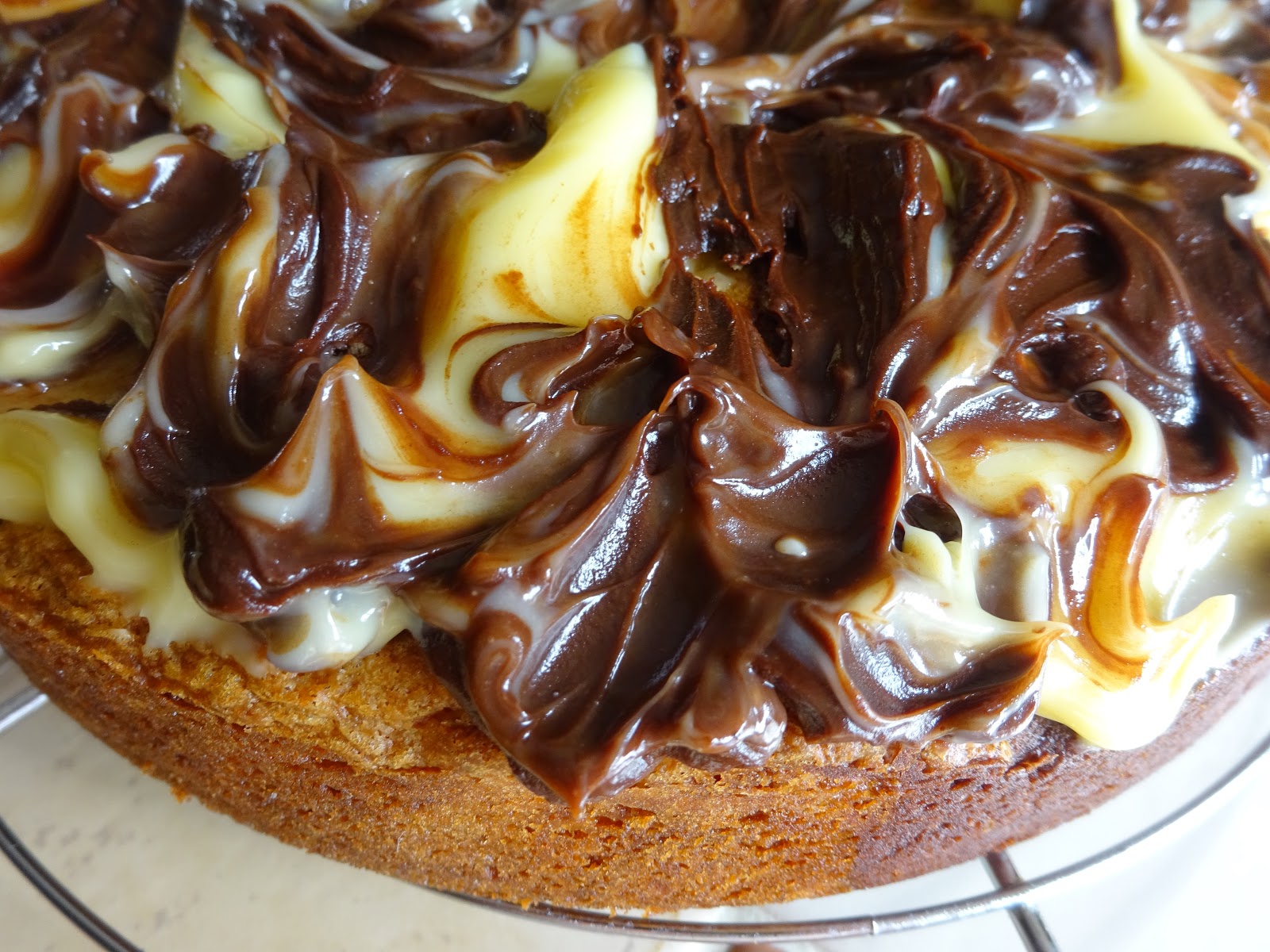
Dark and White Chocolate Marble Cake


I love a good marble cake, but it must be moist and full of flavour. This is doubly so, with a swirly chocolate topping. This recipe is from my clipping folders and is full of white and dark chocolate and ground almonds! Yum. Marble cakes are a pain, as they do use double the bowls but, trust me, this one is worth the extra dishes and clearing up!

You will need a spring form 8 “ cake tin, lightly buttered and the base lined. Pre heat your fan oven to 160C

6 oz chocolate - half white and half plain dark, each melted separately in small bowls, over simmering water or a microwave. In the meantime…..

6 oz softened butter
6 oz caster sugar
3 large eggs, separated
4 oz plain flour 
3 oz ground almonds

In a bowl, whisk your egg whites until you have stiff peaks, set aside for a mo.

In your mixing bowl, cream the butter and sugar until light and fluffy then continue whisking, adding the egg yolks, one at a time along with a small spoonful of the flour with each addition. Stir in the ground almonds.

Now fold in your egg whites along with the rest of the flour, a little at a time, until all is well mixed. Take about half of the mixture out [no need to be too exact] and place in another bowl. Add one chocolate to each bowl and mix well.

Place alternate dessertspoonful dobs of each chocolate mix in your prepared tin and very lightly swirl. Try and level off as best you can without mixing it too much. Bake for about 40 mins until firm. Leave in the tin to settle, then cool on a wire rack.

Topping:

2 oz each of white and dark chocolate
4 oz softened unsalted butter

Chop the chocolates and melt them separately in your microwave, allow to cool for a bit, then beat each into half the butter. Place little alternate dobs on the top and swirl - I used my index finger [after washing it of course!]. Yum yum, piggies bum.

Note: Equally good without the topping.


Tuesday, 11 June 2019


POTATO CAKE

I have been asked to post this recipe by Elaine who has fond memories of tasting it! A very old recipe, although I have never posted it before. I have always had the recipe, from the wonderful Cornish Recipes 1920s book, but never made it, as I was not quite sure about mixing potato and sweet ingredients! BUT how I wish I had done this before! Thanks Elaine, for giving me that jolt. I have used currants, but some would have used sultanas. Your choice. When using inverted commas I am quoting the book. I made half the quantity and this made 12 large squares.

You will need a “hot” oven [210C in your fan oven?] and a greased baking “sheath”.

“1 lb of flour
1 lb boiled potatoes, cold
½ lb grated suet
2 oz sugar
1 oz peel 
pinch salt
¼ lb currants”

“Mix all together with milk or buttermilk, into a stiff dough, roll pout and pout on a baking sheath, lightly cut in squares with a knife, and bake in hot oven.”

I used milk as I had run out of buttermilk. Elaine recalls it made with sultanas. I mashed the potato before adding it to the other ingredients and mixed well before adding the liquid. I used a fraction under 5 fl oz of milk to mix.

Place on your prepared baking sheet, square if off and roll out evenly then cut into squares. I have a small rolling pin and always find it easier to roll out on the sheet.

I baked it for about 35-40 mins, turning down to 200C after 25 mins, then down to 180C for the last 5 mins.

Well, what a surprise! Just delicious, especially buttered!! Plus, just as good the next day. The texture is quite different and a little strange!  I think it needs a tad more sugar though. I should never ever have doubted our forebears!! I do hope you enjoy this Elaine and it brings back many happy memories.


Sunday, 2 June 2019


St Clements Citrus Cake with a lemon icing


I absolutely love the flavours of oranges and lemons. So say the bells of St Clements. Here is just a simple cake, from my folder collection that is full to the brim with those citrus tangs. Intensely orange and lemony. Yum

You will need an 8” spring form cake tin, lightly buttered and lined. Pre heat your fan oven to 150C

6 oz softened butter
6 oz caster sugar, I used golden caster
3 eggs, whisked
2 tablespoonfuls fresh orange juice 
grated zest of two oranges
6 oz SR Flour
5 level tablespoonfuls Lemon Curd

4 oz icing sugar 
lemon zest and juice

In your mixing bowl, cream the butter and sugar until light and fluffy. Add the eggs, one at a time, beating well after each addition then add the orange juice with a spoonful of the flour. Sift the flour over the bowl and fold it into you mix.

Tip into your prepared tin. Take your grated orange zest and stir it into the lemon curd. Add little teaspoonful dobs of this mix all over the top of the cake [not in the exact centre though] and swirl it around carefully with a knitting needle. Bake for about 35-40 mins until firm and golden. Rest in the tin for a few mins before cooling on a rack.

When cold, make a topping with some icing sugar, lemon zest and lemon juice [get zest first]. Cover the cake generously and sprinkle over a little more of the zest. You will love this!! trust me.


Thursday, 30 May 2019


A Penzance Cake


Matthew, originally from Penzance sent me this recipe, with a photo of the page, and so my grateful thanks go to him. The ingredients combination is quite different and so delicious. The cake is very moist and I imagine will be a great keeper. I wonder where it came from and how old it is? Leave for a couple of days at least before cutting.

You will need a 9 inch spring form cake tin, greased and lined. Pre heat your fan oven to 150C.
The recipe below is for a very large cake, so I made half the quantity and used a 6-7 inch square tin, for a change.

1 lb plain flour
4 oz caster sugar
½ teaspoonful bicarbonate of soda
4 oz softened butter
2 teaspoonfuls ground cinnamon
1 lb currants
8 oz crystallised [or stem] ginger, chopped
4 oz chopped mixed peel, finely chopped
2 beaten eggs
5 fl oz tepid milk

In a large bowl, sift the flour, sugar and bicarb and rub in the butter. Add the cinnamon, currants, ginger, and peel and mix to a soft consistency with the eggs and milk.

Tip into your prepared tin and bake for about 1½-1¾ hours until a fine knitting needle comes out clean. My smaller cake took just over an hour. Leave to cool in the tin then turn out onto a rack. Best left for a day or two before cutting.

Just lovely. The high stem ginger content really complements the currants and peel. 

Note: my smaller sized cake took just over an hour to bake, I turned the oven down to 130C  after 45 mins. I have never tried the larger size but I would advice you to turn it down after an hour plus perhaps cover to stop it browning.


Friday, 24 May 2019


London Buns


Another pre war Be-Ro recipe from their baking booklet. This recipe is probably about a hundred years old and it is such a shame we do not bake these kind of buns any more these days. Simple traditional baking, these buns are scone like and great split and buttered. Yum. Best eaten within a day. Just as they cooled my husband ate 3 off the trot. Did you know that SR flour was invented in Bristol in 1845 by a man named Henry Jones who then patented it?

You will need a buttered baking sheet and pre heat your fan oven to 190C

8 oz Self Raising Flour
½ teaspoon salt
2 oz butter [marg in recipe]
2 oz sugar [I used caster]
1-2 oz  mixed peel, very very finely chopped [minute pieces]
1 large egg, beaten [hold back a dessert spoonful for brushing the tops]
2 tablespoonfuls milk
a few drops of lemon extract
Coarse sugar for sprinkling 

Mix the flour and salt in a small bowl and run in the fat. Add the sugar and very finely shredded peel. Add a few drops of the extract to the milk and egg and mix to a dough. Divide into 8 portions, forming into buns in well floured hands. Place on your buttered baking sheet and brush over the left over beaten egg. Sprinkle with coarse sugar and bake for 15 mins.

Mmmmm,  lovely eaten warm, simple baking from a bygone era. Made in minutes, I can just imagine them being made for Sunday tea time.


Note: Coarse sugar? Would there have been demerara a hundred years ago? Actually,  yes. So I am using that.

Tuesday, 21 May 2019


Homemade Candied Mixed Peel


Not to everyone’s taste and yes, it is easy and cheap to buy and us Cornish put it in just about all our baking. What would Heavy Cake be like without that citrus hit? But if you make your own, with one taste you will never go back. For the large jar [and a small tub] in the photo I used 1 red grapefruit, 2 large lemons and 3 oranges. The weight after boiling was 1lb 2oz plus you still have the fruit to eat of course, and I froze the lemon juice.

Peel some oranges, lemons and a grapefruit, making sure you keep the pith attached. Cut it into strips of about an eighth of the fruit. You want all the pieces about the same size. Place them in a saucepan, cover with cold water and bring to the boil. Drain, then repeat 5 times more. But after the final boiling, cover the pan and simmer until the peel is tender. [I will admit this is a pain in the butt]. Throw away the liquid.

You now need to weigh the peel and in the pan add an equal amount of granulated sugar. Add a small amount of water [I used about ¼ pint] and bring to the boil, carefully stirring the sugar to dissolve. Simmer, very lowly, uncovered until you have a very thick syrup, which will probably take about 2 hours. Drain and cool.

Sprinkle caster sugar on a sheet of parchment [on a clean tray] and toss the peel in it until the peel is covered. Preferably in a single layer. Leave it overnight before placing in an airtight clean jar. 

A Great gift too. Will keep for several months in a cool dry place. My next post will be an old Be ro bake that uses the peel - it’s also great on ice cream!


Note: You can make just one flavour, if you wish. 

Saturday, 18 May 2019


PROPER CORNISH RAW FRY

I have not spoken to a single Cornish person, older than myself [70] who has not eaten and enjoyed Raw Fry. A staple in the diets of bygone Cornish folk, miners, fisherfolk and farmers alike, second only to a pasty.  But everyone I have spoken to, has a slightly differing version. My husband remembered his mother using potato and swede, a friend from Stithians, Joyce, says her mother only used potato and onion…. and so it goes on. My good friend Jeny says that her mother always used a shortcrust topping, placing it in a hot oven for about fifteen minutes before serving. But they ALL agreed you start off with bacon!! Proper bacon, that is. I am sure there are as many slight variations as there are villages and towns in Cornwall! Well, almost. Raw Fry has been cooked for ages. I set about trying to re-create the best Raw Fry I could! I was determined not to Post until I was happy with the final result. One thing I found out right away - it is much nicer with swede! Then there is the problem with our “modern” bacon, injected with water. Do NOT use this bacon. I bought a whole ham hock from the butchers in Falmouth and with no water added, I was assured.
Take:
About a small half of a whole hock, chopped with a little fat left on, or a piece of bacon, left whole. I made a delicious Ham, vegetable, bean and potato stew with the other half.
A finely chopped medium onion or large Shallot. Swede and Potato in equal quantities. Poached or fried egg to finish, if you wish, or pop a crust over and bake. Some herbs of your choice perhaps and finally plenty of good seasoning - not too much salt, because of the bacon, but plenty of fresh ground pepper.
Chip the veg as you would do for a pasty, the swede smaller than the potato. Take a small to medium fry pan and heat it up. Fry off some of the pork fat until you have a nice base, then remove it. Now fry the bacon and after a little while add the onion, then the swede. Cook for a few minutes.  Put the kettle on for boiling water.  If there is not a lot of fat, add a little lard or dripping. Now put in the chipped potato and stir, making sure everything is cover with the fat. [here is where I sprinkled in a very small amount of vegetable bouillon, but the ancients would not have had that].  Season well with sea salt and lots of freshly ground pepper. Keep the pan on high and pour over some boiling water until it is within half an inch from the top of the veg and bubbling like mad. [be careful, it will spit]. After a half a minute turn the heat right down and cover.  I used a round of foil, loosely scrunched.  Simmer gently until vegetables are soft. The swede and potato will look the same colour as when they first went in the fry pan,  giving rise to the name of the dish - Raw Fry [or so I have been told]. Top with a poached egg if you wish.  A very quick, delicious wholesome meal, handy for knocking up when you come home from the mines and fields. If some folk were not lovers of bacon, small thin strips of skirt was used instead. I would also imagine some would add chopped parsley or other readily available herbs, like chives as I did. I just went outside my back door and picked some.

Note: Whole large hocks cost around £3.99 and I made two delicious meals from it. The bacon is full of flavour and darker than other cuts. Just lovely and my husband ate the above for his tea, in Cornish heaven as he munched away. The secret is using good bacon, from a whole piece, with NO added water. PLUS, warmed up it is even scrummier, if that is possible.